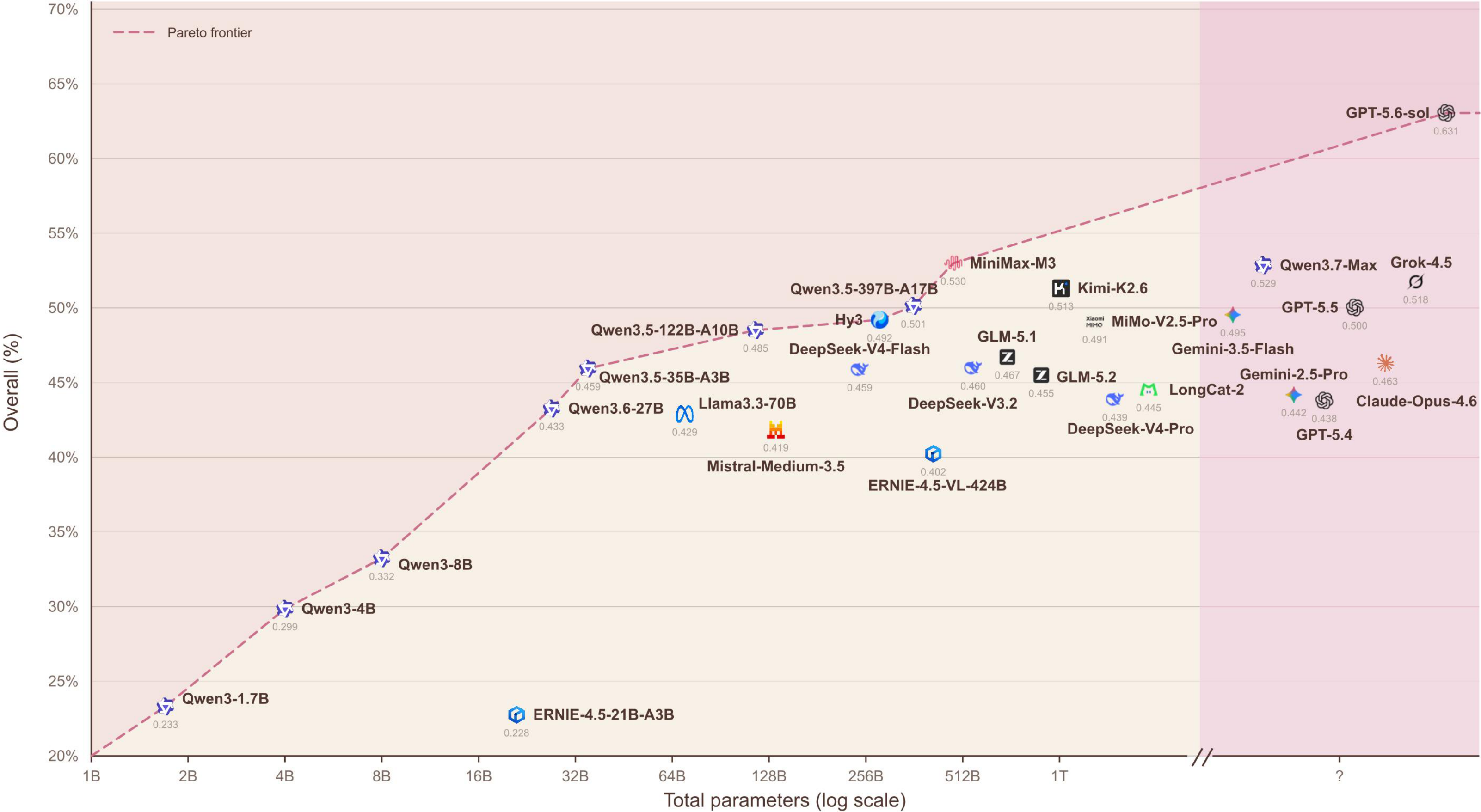
Model scale versus Overall performance on EEGAgentBench. The benchmark reflects broad scaling trends while distinguishing frontier agents beyond raw parameter count and inference cost.
Electroencephalography (EEG) analysis is evolving from short-segment classification toward long-horizon interpretation that demands iterative evidence accumulation, multi-step reasoning, and coordinated use of specialized signal-processing tools. Although large language models (LLMs) have recently shown promise as autonomous agents for EEG analysis, existing EEG agentic evaluations remain fragmented, covering limited tasks over narrow temporal horizons with inconsistent protocols. To address this gap, we propose EEGAgentBench, a unified benchmark for systematically evaluating LLM agents on both short- and long-horizon EEG analysis. It spans six representative EEG applications ranging from knowledge question answering to sleep staging, with signal durations from 2 seconds to nearly 23 hours and prediction targets ranging from class labels to event intervals and epoch-level sequences. The benchmark provides 10 deterministic EEG analysis tools that expose only task-relevant measurements, so agents must select tools autonomously, accumulate evidence iteratively, and construct multi-step workflows. Benchmarking 29 frontier LLMs from 15 model families, we find that EEGAgentBench effectively distinguishes agent capabilities beyond model scale and inference cost, while revealing substantial limitations of current agents in long-horizon EEG analysis, particularly in sustained evidence accumulation and multi-step reasoning.
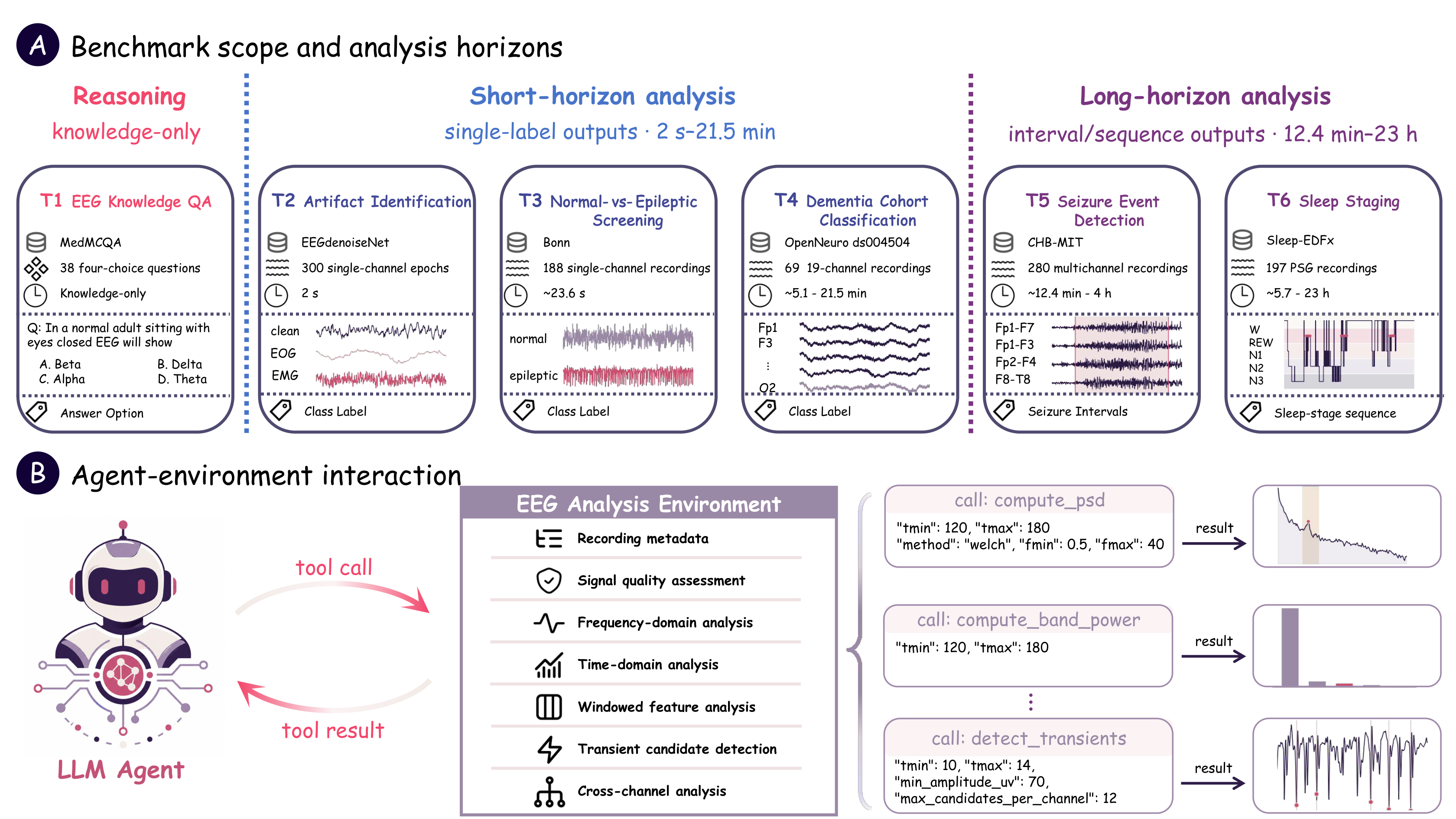
Overview of the six EEGAgentBench tasks and the agent–environment interaction.
KnowledgeT1
Four-choice medical questions on EEG & clinical neurophysiology.
Source: MedMCQA-EEG · N: 38
Signal: No signal
Metrics: Accuracy
Short horizonT2
Decide clean vs. ocular (EOG) vs. muscle (EMG) contamination.
Source: EEGdenoiseNet · N: 300
Signal: 2 s, 1 ch
Metrics: Accuracy, Macro-F1
Short horizonT3
Screen a single-channel epoch as normal or epileptic.
Source: Bonn · N: 188
Signal: 23.6 s, 1 ch
Metrics: Accuracy, Macro-F1
Short horizonT4
Classify resting-state EEG as AD / FTD / HC cohort.
Source: ds004504 · N: 69
Signal: 5.1–21.5 min, 19 ch
Metrics: Accuracy, Macro-F1
Long horizonT5
Localize a variable number of seizure onset/offset intervals.
Source: CHB-MIT · N: 280
Signal: 12.4 min–4.0 h, 18–32 ch
Metrics: Dice-S, Event-F1
Long horizonT6
Produce a full-night 30-s epoch AASM 5-class hypnogram.
Source: Sleep-EDFx · N: 197
Signal: 5.7–23.0 h, 5–7 ch
Metrics: Macro-F1, Cohen's κ
EEGAgentBench formulates EEG analysis as an interactive process between an agent and an EEG environment, following a ReAct-style multi-turn protocol. Instead of exposing raw waveforms, recordings are accessed exclusively through a unified tool interface. At each step, the agent may invoke an EEG analysis tool with user-defined arguments or terminate by submitting a final prediction. All tools perform deterministic analysis without task-specific classifiers or label information, so performance depends entirely on the agent's reasoning, evidence integration, and workflow construction.
The environment exposes 10 EEG analysis tools spanning recording metadata, signal-quality assessment, frequency- and time-domain analysis, windowed feature extraction, transient candidate detection, and cross-channel analysis. The same tool suite is shared across all signal tasks (T2–T6), letting agents build task-specific workflows without predefined pipelines.
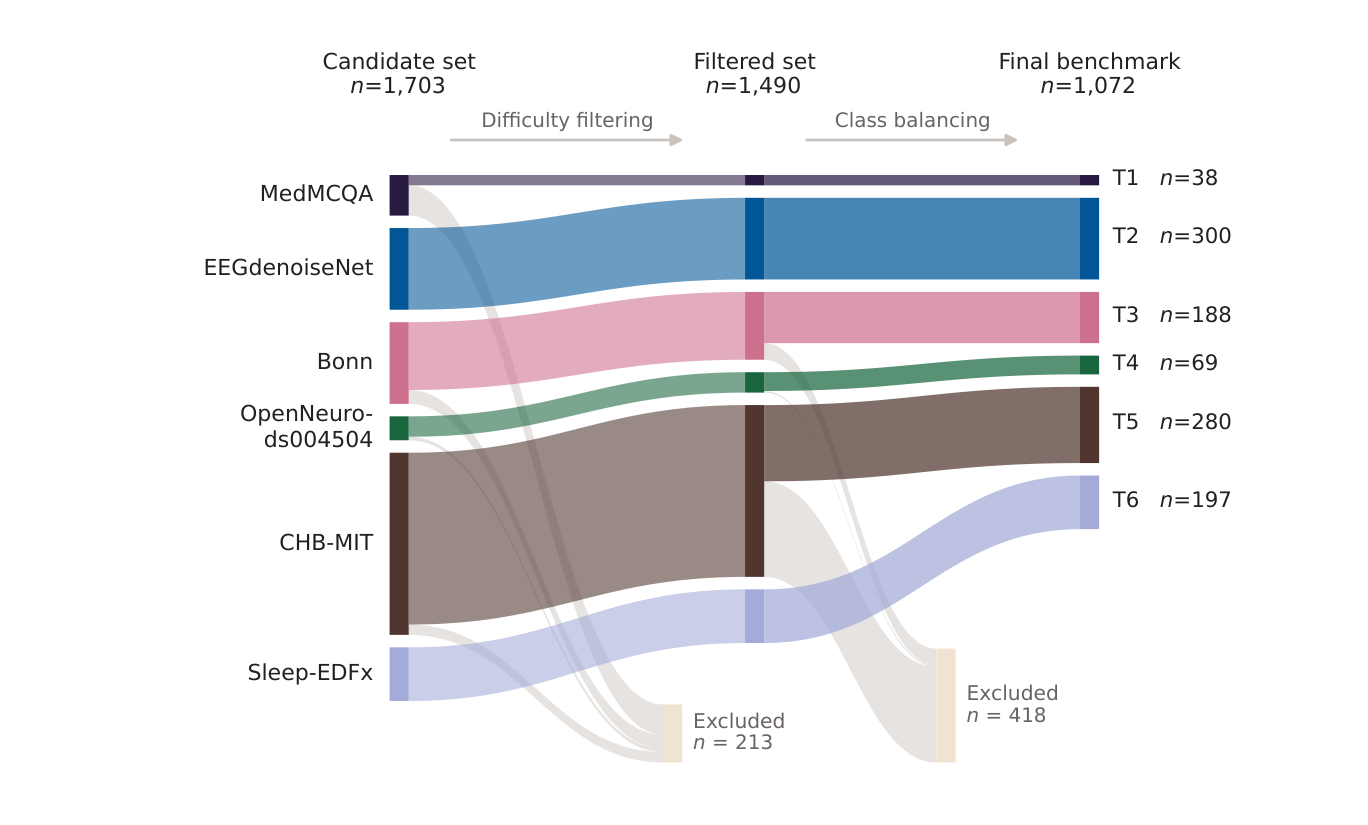
Two-stage benchmark construction: difficulty screening and deterministic class balancing (1,703 → 1,072 instances).
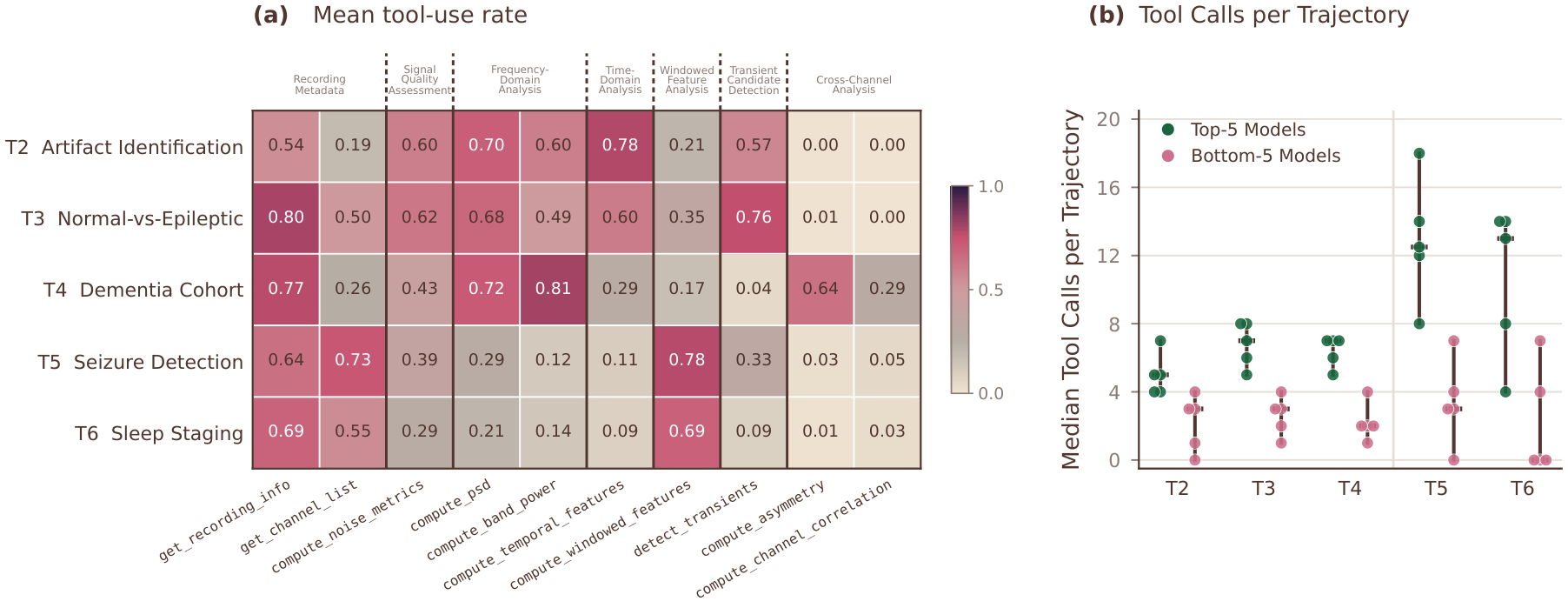
Tool-use behavior across the five signal tasks. Agents adapt tool choices to the task, and top models sustain far deeper analysis on long-horizon tasks.
29 LLM agents evaluated on all 1,072 instances. Blue bold = best, italic = second best.
| Rank | Model | Overall ↑ | T1 | T2 Artifact | T3 Screening | T4 Cohort | T5 Seizure | T6 Sleep | |||||
|---|---|---|---|---|---|---|---|---|---|---|---|---|---|
| Acc | F1 | Acc | F1 | Acc | F1 | Acc | Event-F1 | Dice-S | F1 | κ | |||
| Proprietary models | |||||||||||||
| 1 | GPT-5.6-sol | 0.631 | 0.816 | 0.599 | 0.643 | 0.898 | 0.899 | 0.429 | 0.493 | 0.549 | 0.404 | 0.492 | 0.488 |
| 4 | Grok-4.5 | 0.518 | 0.789 | 0.563 | 0.637 | 0.620 | 0.654 | 0.239 | 0.348 | 0.522 | 0.367 | 0.372 | 0.277 |
| 13 | Claude-Opus-4.6 | 0.463 | 0.842 | 0.498 | 0.567 | 0.543 | 0.612 | 0.294 | 0.362 | 0.289 | 0.366 | 0.312 | 0.204 |
| 7 | GPT-5.5 | 0.500 | 0.737 | 0.651 | 0.690 | 0.543 | 0.612 | 0.194 | 0.333 | 0.530 | 0.449 | 0.347 | 0.263 |
| 21 | GPT-5.4 | 0.438 | 0.684 | 0.730 | 0.733 | 0.790 | 0.798 | 0.205 | 0.319 | 0.069 | 0.063 | 0.150 | -0.004 |
| 19 | Gemini-2.5-Pro | 0.442 | 0.684 | 0.576 | 0.610 | 0.485 | 0.569 | 0.279 | 0.290 | 0.291 | 0.299 | 0.336 | 0.252 |
| 3 | Qwen3.7-Max | 0.529 | 0.763 | 0.747 | 0.770 | 0.909 | 0.910 | 0.208 | 0.319 | 0.325 | 0.305 | 0.219 | 0.094 |
| 8 | Gemini-3.5-Flash | 0.495 | 0.684 | 0.536 | 0.590 | 0.709 | 0.723 | 0.376 | 0.464 | 0.377 | 0.378 | 0.291 | 0.193 |
| Open-weight models: above 1T parameters | |||||||||||||
| 18 | LongCat-2 | 0.445 | 0.737 | 0.532 | 0.557 | 0.724 | 0.739 | 0.255 | 0.348 | 0.242 | 0.250 | 0.182 | 0.054 |
| 20 | DeepSeek-V4-Pro | 0.439 | 0.684 | 0.560 | 0.640 | 0.726 | 0.734 | 0.194 | 0.333 | 0.275 | 0.269 | 0.194 | 0.081 |
| 10 | MiMo-V2.5-Pro | 0.491 | 0.763 | 0.745 | 0.747 | 0.624 | 0.660 | 0.281 | 0.391 | 0.313 | 0.261 | 0.218 | 0.065 |
| 5 | Kimi-K2.6 | 0.513 | 0.842 | 0.642 | 0.670 | 0.767 | 0.777 | 0.272 | 0.319 | 0.347 | 0.341 | 0.208 | 0.071 |
| Open-weight models: 100B–1T parameters | |||||||||||||
| 17 | GLM-5.2 | 0.455 | 0.816 | 0.629 | 0.700 | 0.490 | 0.580 | 0.163 | 0.319 | 0.329 | 0.357 | 0.304 | 0.205 |
| 12 | GLM-5.1 | 0.467 | 0.763 | 0.636 | 0.670 | 0.704 | 0.723 | 0.198 | 0.348 | 0.265 | 0.320 | 0.236 | 0.114 |
| 14 | DeepSeek-V3.2 | 0.460 | 0.711 | 0.631 | 0.693 | 0.776 | 0.777 | 0.163 | 0.304 | 0.271 | 0.258 | 0.207 | 0.075 |
| 2 | MiniMax-M3 | 0.530 | 0.816 | 0.666 | 0.683 | 0.754 | 0.755 | 0.360 | 0.420 | 0.354 | 0.270 | 0.229 | 0.089 |
| 25 | ERNIE-4.5-VL-424B | 0.402 | 0.737 | 0.451 | 0.457 | 0.654 | 0.654 | 0.391 | 0.449 | 0.034 | 0.019 | 0.146 | 0.037 |
| 6 | Qwen3.5-397B-A17B | 0.501 | 0.763 | 0.786 | 0.783 | 0.711 | 0.718 | 0.193 | 0.333 | 0.370 | 0.321 | 0.185 | 0.037 |
| 9 | Hy3 | 0.492 | 0.763 | 0.774 | 0.777 | 0.608 | 0.649 | 0.307 | 0.391 | 0.236 | 0.243 | 0.264 | 0.173 |
| 16 | DeepSeek-V4-Flash | 0.459 | 0.763 | 0.495 | 0.587 | 0.805 | 0.803 | 0.222 | 0.348 | 0.284 | 0.320 | 0.185 | 0.047 |
| 24 | Mistral-Medium-3.5 | 0.419 | 0.737 | 0.505 | 0.580 | 0.568 | 0.628 | 0.220 | 0.348 | 0.264 | 0.274 | 0.217 | 0.079 |
| 11 | Qwen3.5-122B-A10B | 0.485 | 0.711 | 0.701 | 0.710 | 0.656 | 0.676 | 0.338 | 0.420 | 0.298 | 0.250 | 0.208 | 0.067 |
| Open-weight models: 10–100B parameters | |||||||||||||
| 23 | Llama3.3-70B | 0.429 | 0.868 | 0.452 | 0.470 | 0.653 | 0.654 | 0.324 | 0.406 | 0.104 | 0.016 | 0.173 | 0.023 |
| 15 | Qwen3.5-35B-A3B | 0.459 | 0.711 | 0.622 | 0.640 | 0.702 | 0.702 | 0.313 | 0.391 | 0.248 | 0.248 | 0.161 | 0.035 |
| 22 | Qwen3.6-27B | 0.433 | 0.632 | 0.542 | 0.653 | 0.713 | 0.718 | 0.232 | 0.348 | 0.294 | 0.304 | 0.184 | 0.059 |
| 29 | ERNIE-4.5-21B-A3B | 0.228 | 0.526 | 0.167 | 0.333 | 0.301 | 0.394 | 0.220 | 0.217 | 0.000 | 0.000 | 0.151 | 0.010 |
| Open-weight models: below 10B parameters | |||||||||||||
| 26 | Qwen3-8B | 0.332 | 0.632 | 0.221 | 0.347 | 0.488 | 0.521 | 0.287 | 0.362 | 0.143 | 0.036 | 0.224 | 0.081 |
| 27 | Qwen3-4B | 0.299 | 0.395 | 0.405 | 0.417 | 0.509 | 0.548 | 0.248 | 0.304 | 0.047 | 0.014 | 0.188 | 0.065 |
| 28 | Qwen3-1.7B | 0.233 | 0.421 | 0.261 | 0.347 | 0.345 | 0.505 | 0.241 | 0.319 | 0.000 | 0.000 | 0.131 | -0.040 |
Overall is the unweighted mean of T1 accuracy, Macro-F1 for T2–T4 and T6, and Event-F1 for T5.
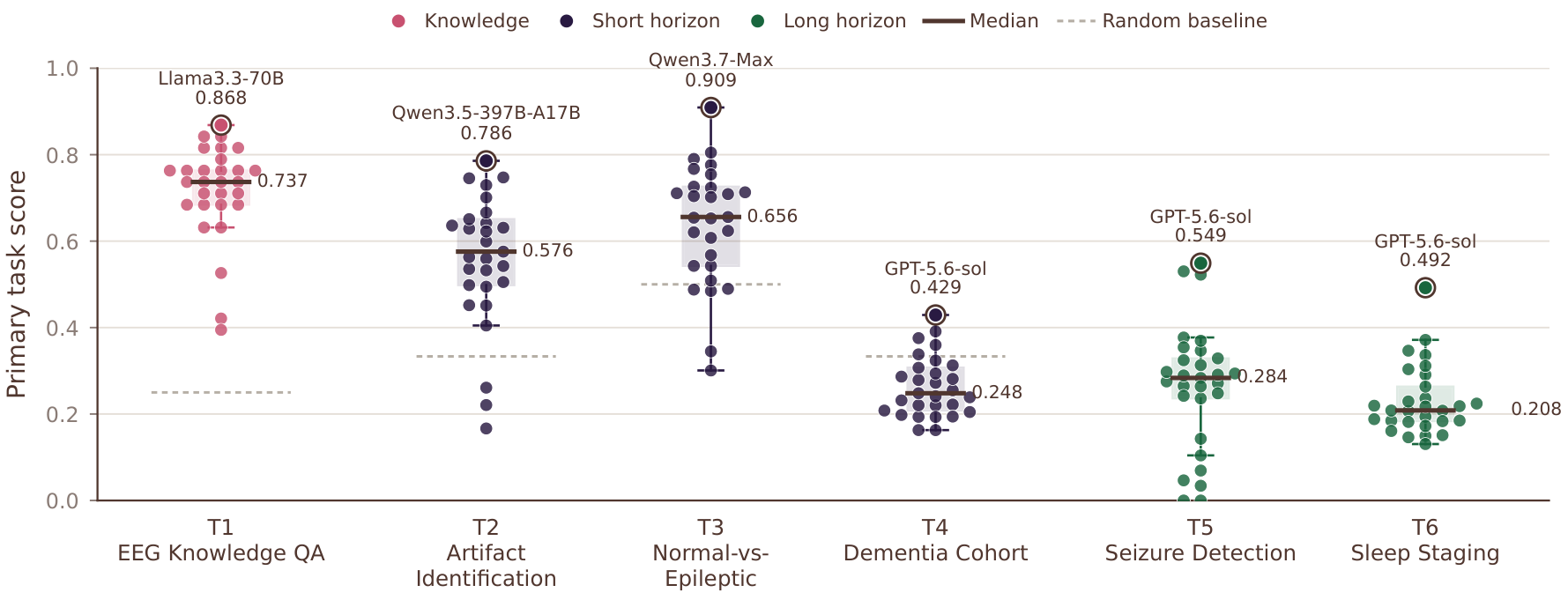
Task-level score distributions separate areas of model competition (T2, T3) from shared bottlenecks (T4, T6).
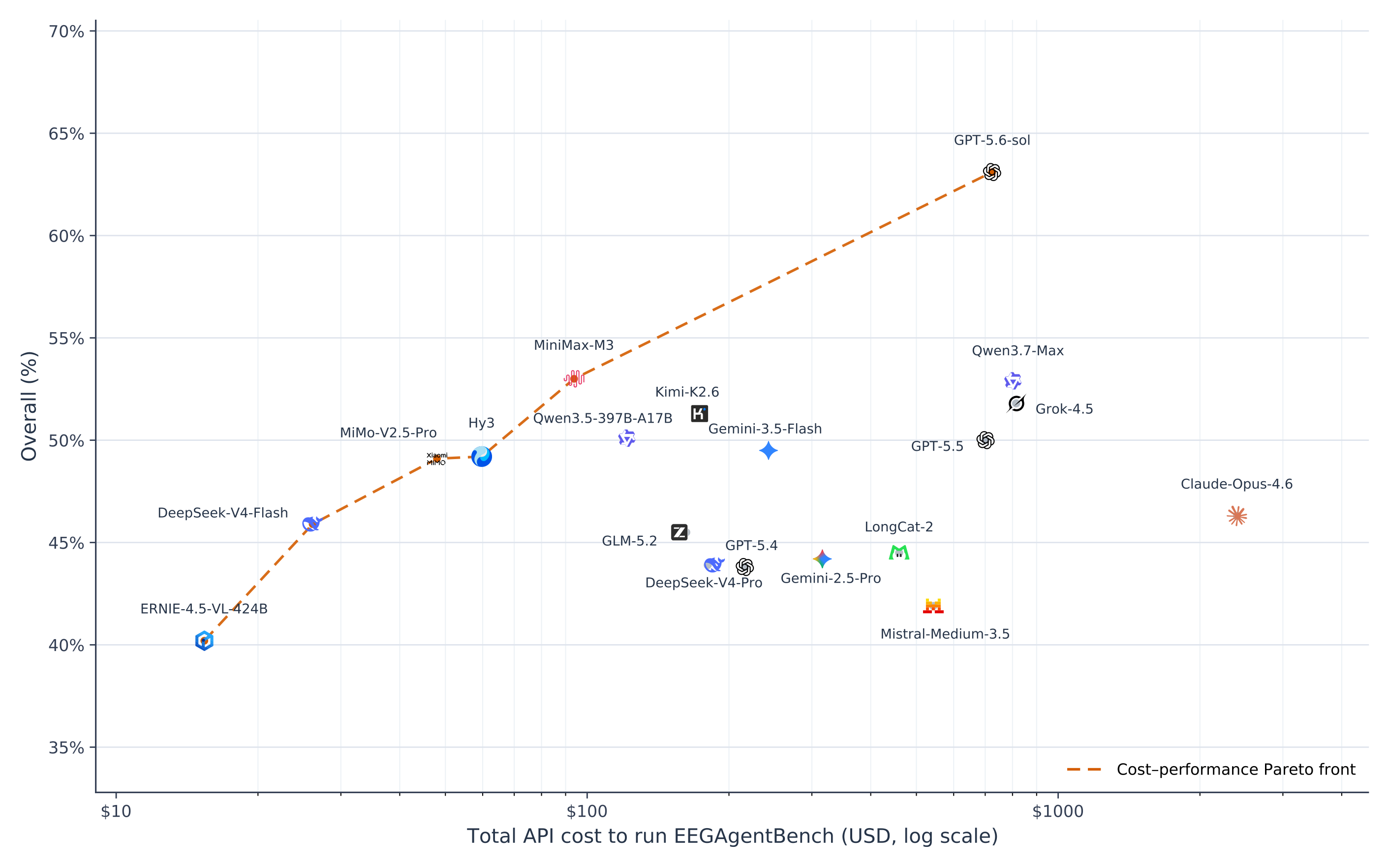
Estimated inference cost vs. Overall (19 models). Higher cost does not consistently yield better performance.
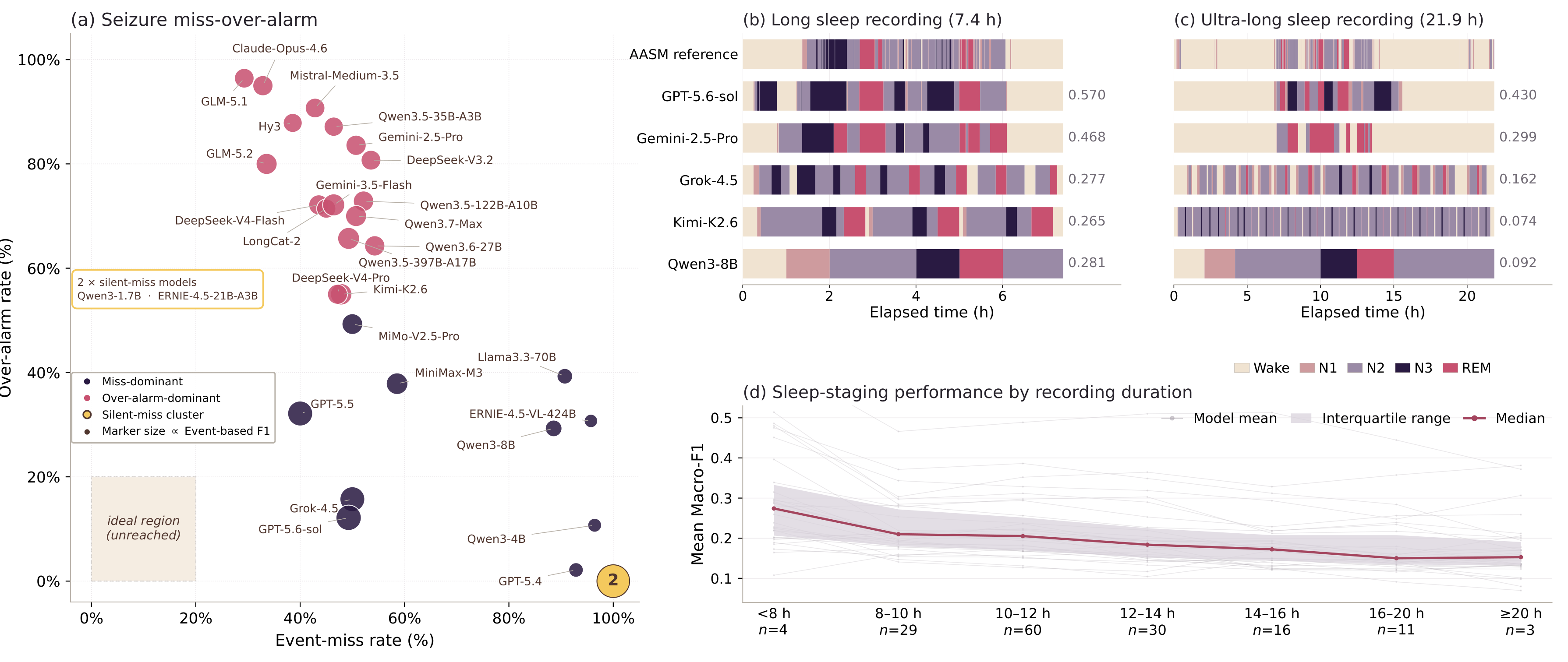
Long-horizon error analysis: seizure miss vs. over-alarm trade-off (T5), representative hypnograms, and the decline of sleep-staging Macro-F1 as recordings lengthen (T6).
Real GPT-5.6 trajectories from EEGAgentBench. For every task we show a successful and a failed run; each turn is collapsed by default — click Expand to reveal the agent's full reasoning, tool call, and raw tool output.
@article{wu2025eegagentbench,
  title   = {EEGAgentBench: Benchmarking LLM Agents on Short- and Long-Horizon EEG Analysis},
  author  = {Wu, Huyu and Weng, Weining and Liu, Yuchen and Gu, Yang},
  journal = {arXiv preprint},
  year    = {2025}
}